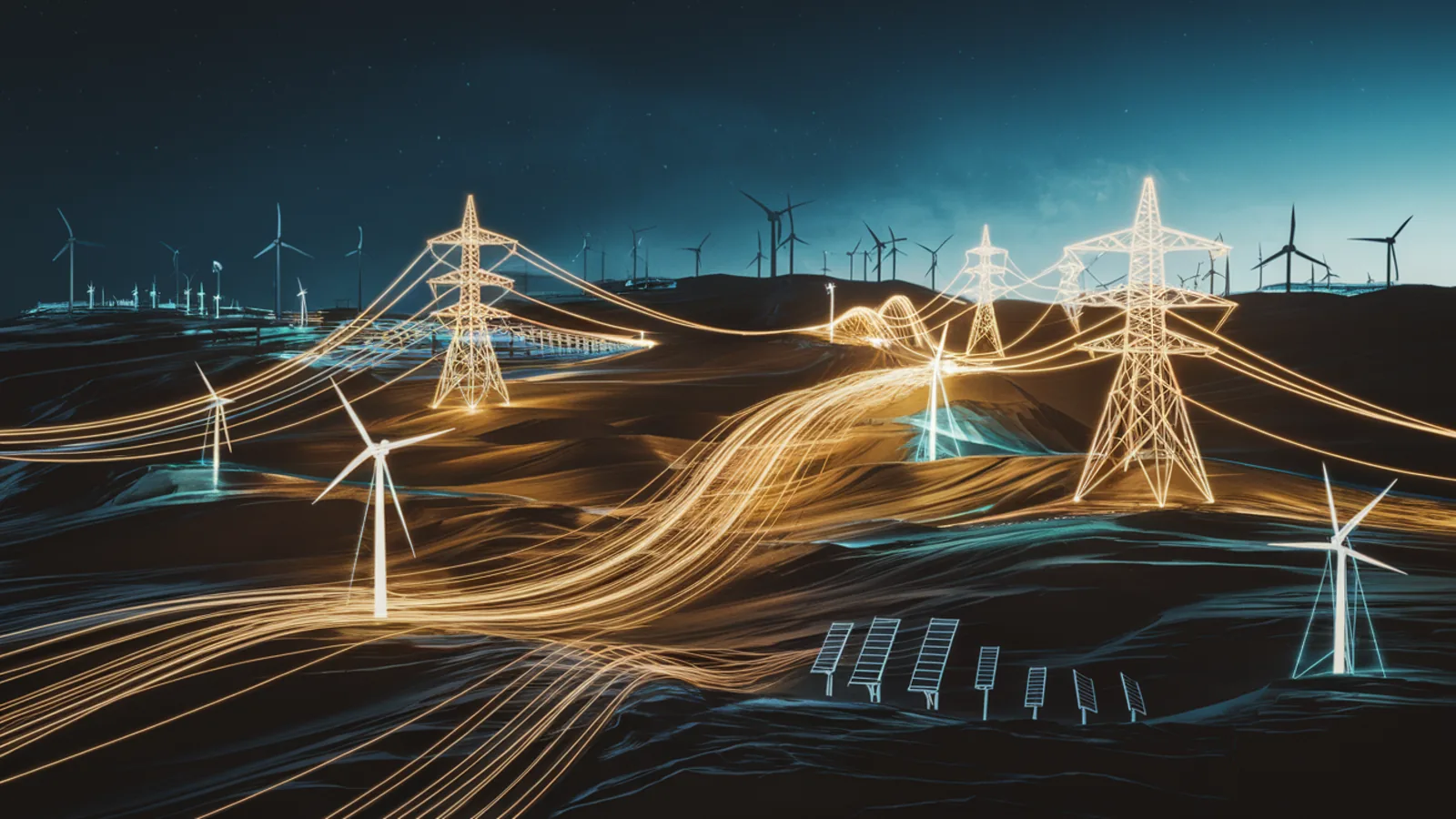
Energy & Climate Desk
Daily energy and climate brief, drawn from a six-persona AI analyst roster: Grid Watch, Barrel Report, Transition Monitor, Carbon Desk, Weather Risk and Watershed.
Published
AI-generated analysis from Apprised's automated desks, synthesized from cited sources and editorially accountable to J.A. Watte. How we report · Corrections.
← Energy & Climate Desk (latest)
Chart auto-generated from this brief's structured fields. See methodology for how the underlying data is collected.
Grid interconnection queue — MISO
- 232,807 MW active in the queue, but only 2.7% has reached an advanced study stage.
- 79.9% of all resolved megawatts withdrew rather than reaching service.
- Of 557 completed interconnection agreements, 268 have not started construction and 92 are generating — a signed agreement is not a power plant.
- Queue entry to an executed agreement runs 3.3 years (n=384); queue entry to actually in service, 3.1 years (n=90).
Today’s Snapshot
AGC Freezes Green Hydrogen Plant Build as H2 Economics Bite
Japanese glass and chemical conglomerate AGC has frozen construction of a green hydrogen material plant, the latest signal that the economics of green hydrogen infrastructure remain deeply challenged even among committed industrial adopters. The freeze reflects a widening gap between political targets for hydrogen-based decarbonization and the on-the-ground cost realities facing manufacturers. With electrolyzer costs, electricity prices, and offtake uncertainty all squeezing project economics, AGC's pause joins a growing list of hydrogen project deferrals globally. For U.S. audiences, the move is a leading indicator: American industrial hydrogen ambitions — backstopped by IRA hydrogen production tax credits — face similar structural headwinds if power costs and demand aggregation don't materialize on schedule.
Synthesis
Points of Agreement
Transition Monitor reads the AGC freeze as confirmation that deployment curves are trailing targets due to cost-structure mismatches; Carbon Desk reads it as a stranded-capex and climate-finance integrity signal; Grid Watch reads it as a direct consequence of grid electricity pricing. All three agree on the proximate cause: the fundamental economics of green hydrogen do not yet close at industrial scale under current power cost conditions, and this freeze is a symptom of that shared reality, not an isolated corporate event.
Points of Disagreement
Transition Monitor frames the freeze as a timing problem — the cost curves are moving right, just not fast enough — implying eventual resolution if policy holds. Carbon Desk is more structurally pessimistic, arguing that the gap between commitments and verified deployment is widening and represents a systemic mispricing risk in climate finance instruments. Grid Watch refuses to treat this as a technology-trajectory question at all: it is a grid infrastructure and electricity market design problem, and until transmission buildout and renewable capacity factor improvements close the gap, no amount of electrolyzer cost reduction solves the fundamental constraint. The tension is whether this is a 'not yet' story (Transition Monitor), a 'mispriced risk' story (Carbon Desk), or a 'wrong diagnosis' story (Grid Watch).
Pivotal Question
What data point would move Grid Watch's view toward Transition Monitor's cautious optimism? Evidence that U.S. or Japanese grid operators are clearing interconnection queues for co-located renewable-electrolyzer projects at scale, or that power purchase agreements for electrolysis are being signed at sub-$0.04/kWh in curtailment zones — that would shift the grid constraint from 'structural barrier' to 'solvable bottleneck.' Conversely, what would move Transition Monitor toward Carbon Desk's harder skepticism? A pattern of IRA 45V credit applications being denied or withdrawn at scale, signaling that even with policy support, the compliance architecture cannot mobilize industrial capital.
Bias Flags
- Transition Monitor: Deployment-curve optimism may underweight how durable permitting and grid interconnection bottlenecks are — 'cost curves bending right' does not automatically translate into projects reaching financial close.
- Carbon Desk: Finance-first framing reduces the AGC freeze to a pricing and disclosure problem, potentially underweighting non-market factors: industrial policy durability, geopolitical energy security motivations, and Japan's structural energy import dependence, which may sustain hydrogen investment regardless of near-term IRR.
- Grid Watch: Engineering-constraint focus may underestimate the degree to which financial innovation (e.g., hydrogen banks, long-term offtake contracts backstopped by government guarantees) can de-risk projects even before the grid infrastructure fully catches up.
Routing
Voices seated: Transition Monitor, Carbon Desk, Grid Watch
The sole energy-relevant story in today's corpus is AGC's freeze on green hydrogen material plant construction in Japan — a transition-infrastructure signal that routes primarily to Transition Monitor, with Carbon Desk weighing the stranded-investment and decarbonization-finance angle, and Grid Watch flagging the downstream implications for hydrogen-as-grid-flexibility.
Analyst Voices AI analysis
Transition Monitor Dr. Amara Osei
AGC's construction freeze is not a one-off corporate decision — it is a data point in a pattern. Green hydrogen has been the most policy-beloved and deployment-laggard technology in the decarbonization stack for three consecutive years. The target says hydrogen covers 10% of final energy demand by 2050. The project pipeline says deferrals are accelerating. The electrolyzer cost curve is bending in the right direction — BloombergNEF has tracked roughly 40% cost reductions since 2020 — but 'right direction' is not the same as 'far enough, fast enough.' AGC makes specialty materials for fuel cells and electrolyzers; this is not a fringe hydrogen play. When a tier-one supplier to the hydrogen supply chain freezes its own upstream build, you are watching the ecosystem eat itself before it matures.
The U.S. dimension matters here. The IRA's Section 45V hydrogen production tax credit was designed to pull exactly this kind of industrial investment forward. But the Treasury's 'three pillars' rules — additionality, temporal matching, deliverability — have created compliance uncertainty severe enough to paralyze capital allocation. Projects that looked fundable in 2023 are in limbo in 2026. The AGC freeze in Japan is a culturally distinct but structurally parallel story: when policy design and project economics don't lock together tightly, industrial capital goes to the sideline. The supply chain says maybe — and 'maybe' is where green hydrogen has been living for two years too many.
AGC's plant freeze is a supply-chain canary: green hydrogen's deployment curve is being strangled by the gap between electrolyzer cost trajectories and current power price and offtake realities, a dynamic mirrored in U.S. IRA hydrogen credit uncertainty.
Bias flag — Deployment-curve optimism may underweight how durable permitting and grid interconnection bottlenecks are — 'cost curves bending right' does not automatically translate into projects reaching financial close.
Carbon Desk Henrik Lindqvist
Price the freeze. AGC's decision to halt construction is a stranded-capex signal dressed up as a schedule adjustment. The market question is simple: what discount rate was embedded in the original investment decision, and what has changed? Green hydrogen project IRRs are extraordinarily sensitive to power purchase agreement pricing, which in Japan — without the electricity market liberalization depth of Europe or the cheap renewables buildout pace of the U.S. — remains stubbornly high. When the power input cost doesn't fall fast enough, the carbon abatement cost per ton implied by green hydrogen production climbs into ranges that no voluntary carbon market, no compliance scheme, and no industrial offtaker wants to touch at scale.
The broader climate finance signal is this: voluntary commitments to hydrogen-based decarbonization are running well ahead of verified capital deployment. The commitment is hydrogen-ready industry by 2035. The verified reduction from hydrogen substitution is, globally, still rounding-error territory. Projects like AGC's represent the gap between those two numbers. For investors holding positions in hydrogen-linked equities or green bonds with hydrogen-use-of-proceeds language, the freeze is a disclosure event waiting to happen. If one tier-one materials supplier is pausing, how many others are in the same position but haven't announced? The verified reduction is not 3% — it's closer to 0.3% — and freezes like this are why.
AGC's freeze crystallizes the stranded-capex risk embedded in green hydrogen's investment thesis: implied carbon abatement costs remain uncompetitive, and the gap between hydrogen decarbonization commitments and verified deployment is widening, not closing.
Bias flag — Finance-first framing reduces the AGC freeze to a pricing and disclosure problem, potentially underweighting non-market factors: industrial policy durability, geopolitical energy security motivations, and Japan's structural energy import dependence, which may sustain hydrogen investment regardless of near-term IRR.
Grid Watch Lena Hargrove & Sam Okafor
We are going to say something that gets lost in the hydrogen narrative: the grid is the reason this freeze happened, and the grid will be the reason the next freeze happens too. Green hydrogen is fundamentally an electricity product. Every kilogram of green H2 requires roughly 55 kWh of electricity input via PEM electrolysis under best current conditions. At Japanese industrial power prices — averaging above $0.15/kWh — that is a $8-plus power cost per kilogram before you touch electrolyzer CAPEX, compression, storage, or distribution. The grid has not delivered the low-cost renewable electricity hours that green hydrogen economics require. That is not a technology problem. That is a capacity factor and grid pricing problem.
The U.S. parallel: regions with high renewable curtailment — ERCOT's West Texas zones, parts of MISO — theoretically offer the cheap electrons that could make electrolytic hydrogen viable. But the transmission infrastructure to co-locate electrolyzers with curtailment zones at industrial scale does not exist today, and the interconnection queue backlogs mean it won't exist on any near-term timeline that justifies locking in capital now. The policy assumes electrons that do not yet exist — cheap, clean, available at the hours electrolyzers need to run at the capacity factors that make the economics work. AGC read the grid math and blinked. Rational actors do that.
AGC's freeze is ultimately a grid economics decision: green hydrogen requires cheap, abundant renewable electricity hours that neither Japan's nor most of the U.S. grid currently delivers at the capacity factors needed to justify electrolyzer capital deployment.
Bias flag — Engineering-constraint focus may underestimate the degree to which financial innovation (e.g., hydrogen banks, long-term offtake contracts backstopped by government guarantees) can de-risk projects even before the grid infrastructure fully catches up.
Simulated Opinion
If you had to form a single opinion having heard the roundtable, weighted for known biases, it would be this: AGC's freeze is a more durable warning signal than the transition-optimist framing allows. The cost curves for electrolyzers are real, but Grid Watch is correct that they solve only one third of the equation — cheap electricity and reliable offtake are the other two legs, and neither is close to solved at the project-finance level. Carbon Desk's stranded-asset concern is the most underpriced risk in the hydrogen investment thesis right now: a significant portion of the capital committed to hydrogen-economy buildout — in Japan, in Europe, and in IRA-backstopped U.S. projects — is implicitly betting on grid and policy conditions that are not yet materialized and may not arrive on the schedules those bets require. The prudent read is not that green hydrogen is dead, but that the 'bridge to viability' is longer and more expensive than the policy targets and corporate commitments publicly suggest, and AGC's freeze is one of the cleaner honest signals the market has produced on that question in recent months.
Watch Next
- U.S. Treasury IRA Section 45V hydrogen credit guidance: any rule clarification or compliance pathway update would either unlock or further freeze stalled U.S. electrolyzer project capital within 30-60 days of announcement
- AGC earnings call or investor materials for explicit commentary on the freeze duration, restart conditions, and whether other hydrogen-material product lines are under review — this would reveal whether the freeze is tactical (temporary cost-deferral) or strategic (exit from the hydrogen materials thesis)
- METI Japan hydrogen strategy implementation reports: Japan's Ministry of Economy, Trade and Industry has committed to $3.4B in hydrogen subsidies through its GX implementation plan — any signal of subsidy disbursement delays or program revision would amplify the AGC freeze as a sector-wide signal rather than a company-specific one
- DOE Loan Programs Office hydrogen project announcement pipeline: if LPO conditional commitments for hydrogen projects begin expiring without conversion to full commitments, that would confirm that the U.S. IRA hydrogen buildout is experiencing the same capital-freeze dynamics as Japan
Historical Power Lenses AI analysis
Andrew Carnegie 1835-1919
Carnegie's defining strategic insight was vertical integration: control the ore, the coke, the furnaces, and the rails, or be vulnerable at every node. AGC's position — making specialty materials for electrolyzers and fuel cells — is the early-Carnegie position of supplying inputs to an industry whose downstream demand has not yet materialized at scale. Carnegie faced exactly this problem in the 1870s when he held steel capacity for a railroad buildout that kept getting delayed by capital market contractions. His response was not to freeze but to cut costs so aggressively that he could survive on thin margins until demand arrived. AGC's freeze suggests the company has made the opposite bet: that waiting out the capital cycle is cheaper than building into an unproven demand curve. Whether that is Carnegie-level patience or Carnegie-level miscalculation depends entirely on whether the hydrogen demand curve is real or a policy fiction.
J.P. Morgan 1837-1913
Morgan's approach to industrial risk was to refuse to fund a sector until it had been rationalized — he would not finance competing railroads; he would finance the railroad that survived the competition. The green hydrogen sector in 2026 looks like the U.S. railroad sector in 1875: overcapitalized at the vision layer, undercapitalized at the infrastructure layer, with too many competing technology standards and not enough consolidating capital to force a dominant design. Morgan would read AGC's freeze not as a failure of the hydrogen thesis but as the market's correct signal that consolidation has not yet happened. He would be waiting — as he waited with railroads and then with steel — for the moment when distressed assets could be assembled into a rationalized structure. The freeze is the precondition for the deal, not the death of the sector.
Sun Tzu 544-496 BC
Sun Tzu's counsel was that the general who knows when not to fight wins as surely as the one who wins in battle. AGC's decision to freeze construction is, in this reading, strategic non-engagement: refusing to commit capital to a battlefield — the green hydrogen cost curve — where the terrain has not yet shifted in the investor's favor. The parallel is Sun Tzu's concept of 'shi' — waiting for the force of circumstances to create advantage rather than manufacturing it through premature action. The risk in this posture, as Sun Tzu also noted, is that hesitation can become permanent inaction when competitors who did not pause accumulate the operational learning curves that make them structurally cheaper. AGC is betting that the terrain will shift before the learning curve penalty compounds.
Thomas Edison 1847-1931
Edison's greatest strategic error was not technical but commercial: he over-invested in DC infrastructure at a moment when the cost curve and network economics were moving inexorably toward AC. The green hydrogen parallel is direct — multiple competing hydrogen production pathways (green, blue, pink, turquoise) are still contesting for dominant design, and capital deployed into one pathway's supply chain before the competition resolves risks the same stranding Edison suffered when Westinghouse's AC system swept the market. AGC, as a materials supplier, faces Edison's exact dilemma: build the infrastructure for the technology you believe will win, or wait until the standards war resolves. Edison built — and lost. The question for AGC and the green hydrogen materials sector is whether the freeze is wisdom learned from Edison's mistake, or simply fear dressed up as strategy.